Introduction
Why an aerial activity works for a stag or hen party
A shared flight turns a group into a team from the very first minute: measured excitement, photos that last, and a common story told for years. This guide brings together four paths to the sky—hot air balloon, tandem paragliding, paramotor, and skydiving—with options for calm profiles and for those seeking maximum adrenaline.
Imagine the silence of dawn when the flame ignites the balloon and the basket rises. The range of intensity is wide: from a gentle balloon ride to the brief roar of freefall.
It works for groups of 6 to 12 people. There are concentrated schedules, providers that reserve adjacent seats or private baskets, and fixed packages that avoid a thousand decisions. Photography is easy and powerful: the light at dawn, the clear horizon, and faces of spontaneous triumph.
What you will find here and how to choose
Four ways to fly, four levels of vertigo, and the same question: which one fits your group? This guide brings together ballooning, paragliding, paramotor, and skydiving for stag or hen parties in Spain.
Each experience comes with what it includes: equipment, basic insurance, and a briefing. You will also see age, health, and weight requirements, and when and where to fly in Spain, with ideas for nearby accommodation and how to get there.
To choose, combine three variables: budget, vertigo tolerance, and group logistics. If you want photos and calm, go for a balloon; if you seek controlled movement, paragliding or paramotor; if you dream of the big rush, skydiving.
Upon arriving at the airfield, the smell of freshly watered countryside greets you before takeoff. At the end of the guide, you have a comparison, direct tips, and an FAQ to finalise your decision.
Picuco te puede ayudar
Does something here catch your eye?
Tell us.
Write to us on WhatsApp or email: we answer questions, find the best options and help you sort out the booking.
Essential information for aerial activities: what is included, age and requirements
All activities include a safety briefing, specific equipment, a certified pilot or instructor, and basic civil liability insurance. Always confirm the scope of the accident insurance.
The State Air Safety Agency (AESA) and the European EASA regulations set the safety framework and pilot licences. You do not need previous experience for tandem flights or for hot air ballooning.
The faint smell of fuel from the burner or the engine, mixed with a cool breeze, suddenly places you in the big day.
What each activity includes
- The paramotor has a typical flight duration of 15-30 minutes.
- Tandem skydiving includes an ascent in a plane to 3,000–4,000 m, with 35–50 s of freefall and 5–7 min under a canopy.
Photos and video are almost always optional and at an additional cost. If you go as a group, ask for a joint pack to have consistent material.
Age, weight and health
Hot air ballooning is very accessible: minors go accompanied and with enough height to see through the basket, and some companies recommend ages from 6 years upwards. Pregnancy and reduced mobility require prior consultation.
Paragliding and paramotor usually admit minors with authorisation and a typical weight between 30 and 130 kg. Being able to walk a few metres at takeoff is valued; in a trike, there is no need to run.
In tandem skydiving, ages from 16 are usually accepted with written authorisation from guardians. Check if there are surcharges for weight.
Anyone with heart problems, unstable blood pressure, or recent surgeries must provide a medical certificate or refrain from participating.
Documents and booking
Bring your ID or passport on the day of the flight or jump, the informed consent, and the signed assumption of risk. For minors, the centre will require the original authorisation and the presence of the legal guardian.
In a hot air balloon, the limitation is due to the total load of the basket, and groups are distributed to balance weights. In tandem flights, if you are close to the limit, say so when booking to assign the appropriate pilot and sail.
Wear closed shoes and clothing suitable for the expected temperature: it is always colder up high than you expect. Do not consume alcohol in the 12 hours prior and arrive well hydrated.
For groups, an advance payment of 20–30% is standard, with the balance due on the day of the activity.
Weather, cancellations and insurance
Strong winds, rain, or low cloud cover can cause cancellations. The balloon requires calm at sunrise; paragliding and paramotoring suffer from gusts and thermal turbulence, and skydiving is cancelled due to cloud cover that prevents the minimum altitude or due to excessive gusts.
If the weather forces a postponement, you will be offered a new date at no cost or a voucher. Request the conditions and timeframes in writing.
Confirm the personal accident coverage and whether it includes medical assistance; many operators offer optional extensions.
Which activity suits each group?
The hot air balloon is the most inclusive for diverse groups and those with mild vertigo. Tandem paragliding and paramotoring suit those who want movement and close-up landscapes, while skydiving requires a greater mental commitment.
When, where and logistics: best areas and seasons in Spain (Includes accommodation and how to get there)
Spain has stable plateaus for hot air balloons, thermal mountain ranges for paragliding, coastal plains for paramotoring, and aerodromes with wide skies for skydiving. With that as a base, the season and the area matter more than the budget.
Hot air balloons fly all year round. The Meseta offers greater stability in autumn and winter, while the north and the Mediterranean work well with mild springs. Flights depart at sunrise, when the wind is most docile.
For tandem paragliding, spring and autumn are ideal due to moderate thermals. In summer, coastal areas respond better, with laminar breezes. Paramotoring requires sunrise and sunset, with clear winters in the interior and mild summers on the coast. In skydiving, centres operate almost all year round: avoid days with storms or persistent low cloud cover.
Areas by activity
Paramotoring works well in delta and coastal areas: the Ebro Delta or the Costa del Sol, with take-offs in authorised fields. For skydiving, there are large centres near Madrid, in Girona (Empuriabrava), in Sevilla, and at other regional aerodromes. Choose the one that is best connected by transport.
How to get there and where to sleep
The AVE and medium-distance rail networks connect capitals with nearby hubs, but you will need to arrange a taxi or a rental car for the final leg. A car is the most flexible option for sunrise schedules: allow margin for secondary roads and possible fog.
Meeting points are aerodromes, take-off fields, and rural car parks. The GPS location and the mobile contact for the ground team are usually sent the day before.
- For sunrise hot air ballooning, look for a rural house or hotel in the valley itself, less than 30 minutes from the meeting point.
- For paragliding or paramotoring, group apartments or campsites with bungalows provide showers and a bar after the flights.
Group coordination
Don't pack the same day too tightly: book your flight for the morning and leave lunch or the subsequent activity with a flexible schedule. If there are no simultaneous slots, split the group and alternate with a short route or a brunch nearby. Designate one person as the contact for the operator and another for transport logistics and payments.
In towns and regions, these activities support bars, accommodation, and workshops: show your gratitude through local consumption and by taking care of the environment.
Aerial activities for stag or hen parties: hot air balloon, paragliding, paramotor, and skydiving
1. Hot air balloon: a ride, a toast, and photos that last for years
The hot air balloon is the most inclusive plan for a mixed group: it requires no effort or tolerance for vertigo and provides group photos from the air. The appointment is usually at sunrise, when the air is calmest.
The experience begins with the inflation of the canvas and the burner, and in a few minutes, you are floating in silence over fields, rooftops, and rivers. The basket barely shakes, like a gentle boat on a lake, when changing air layers.
Count on 3–4 hours in total including setup, flight, and return, and it often ends with a toast or a countryside breakfast. Some flights include a toast with sparkling cider, lunch with Iberian cured meats, a certificate of the trip, and photographs and videos of the activity.
To reserve your spot, you must pay the amount, and it is advisable to do so in advance. Some companies recommend ages from 6–8 years upwards, and minors must be accompanied.
If you are going on a stag or hen party, ask for a banner with the protagonist's name, group photos during inflation, and an accessible meeting point for taxis. Wide valleys and historic cities with iconic views work well; operators with daily departures during the season offer more rescheduling flexibility.
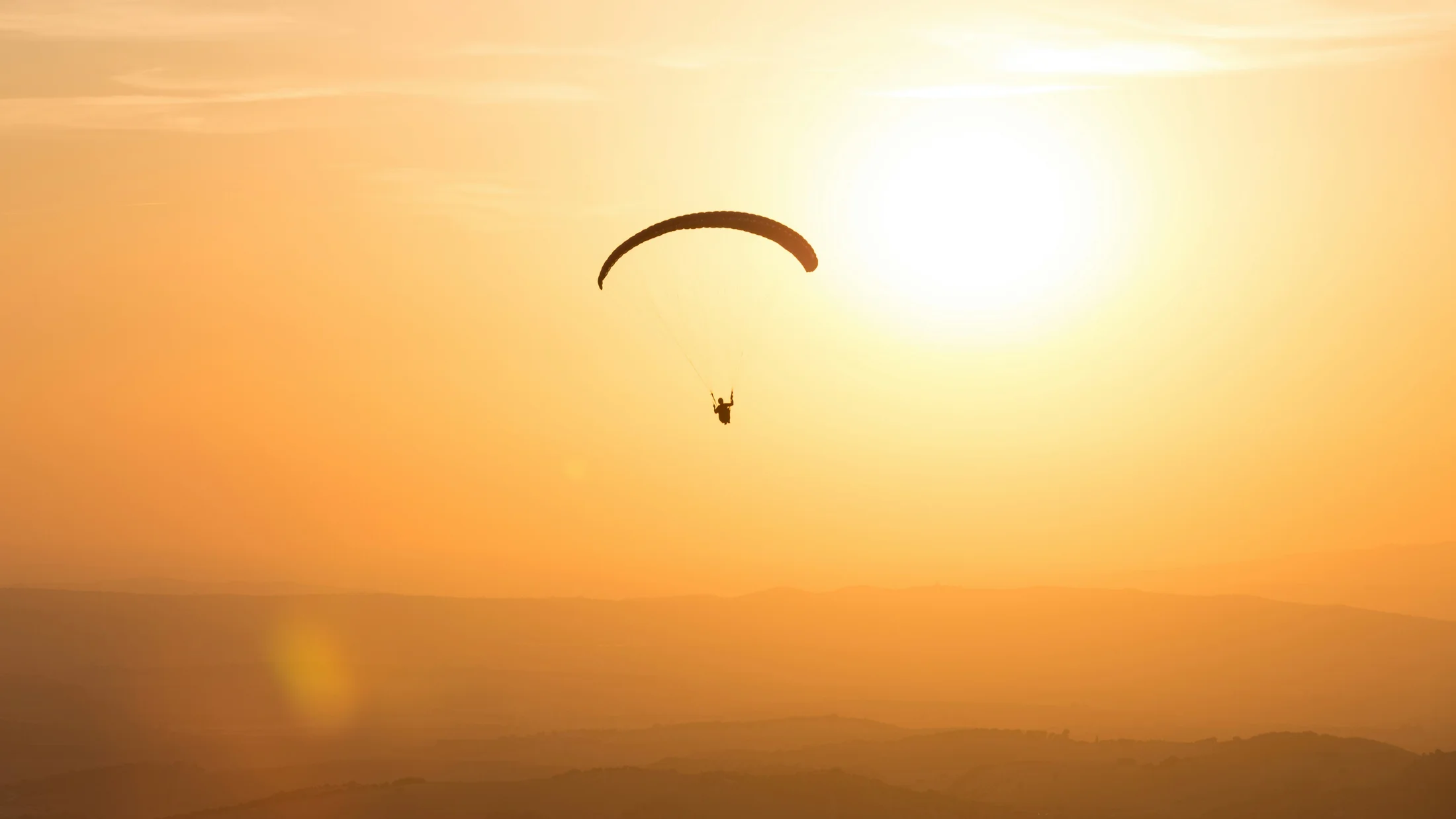
2. Tandem paragliding: float, turn, and play with thermals
In tandem paragliding, you fly sitting in a chair shared with your pilot, without any prior course. You only have to follow two clear orders: one during takeoff and another during landing.
The flight is a glide, with gentle turns over the landscape. If the group wants more excitement, many pilots perform light manoeuvres without compromising safety. The sound of the wind in the helmet is a constant whisper.
The usual requirements are to weigh between 40 and 110 kg, wear closed footwear, and be able to jog a few steps.
Some operators offer group packs with consecutive slots and pick-up transfers. Ask about them when booking if there are several of you.
The plan fits perfectly with a morning of flights and an afternoon at the beach or on a short route. While some are flying, the rest of the group can record from the ground.
3. Paramotor: the motor advantage to go further
It is the option if someone in the group does not want to run during takeoff.
The motor allows you to travel along the coast, rivers or marshes with freedom, making turns and routes without depending on the wind direction. You also return to the starting point with precision. The sensation is like a smooth flying carpet, with the constant hum of the motor behind your back.
A typical flight lasts between 15 and 30 minutes, and sometimes 40 minutes on special tours. The most popular areas are the Ebro Delta, the open stretches of the Costa del Sol and the inland fields with authorised airspace.
Before flying, check that your weight is within the equipment ranges (between 30 and 130 kg) and bring a helmet and warm clothing. The passenger does not need certification; the pilot must be qualified. Let us know about allergies, phobias or limitations to adapt the flight.
Prices range from 80 to 150 € per person, with photos and video from an on-board camera being optional. The time and coordinates are confirmed 24 h before via WhatsApp depending on the wind. For stag or hen parties, ask for consecutive slots and a base with shade and drinks, so that the group experiences it like a festival on the runway.
4. Tandem skydiving: the great adrenaline rush
A tandem parachute jump gives a stag or hen party 35–50 seconds of freefall and 5–7 minutes of gliding under a canopy until landing. The day starts with a 15-minute briefing, the equipment and the assignment of an instructor, and you fly up in a plane to 3,000–4,000 metres.
It is advisable to arrive between 30 and 45 minutes before the scheduled jump time. At 4,000 metres the temperature is about 25 °C lower than on the ground, so bring appropriate clothing.
Typical requirements are being at least 16 years old with parental authorisation, not consuming alcohol before or during the activity and arriving well-rested. People aged 70 or older need a medical form signed and stamped by their doctor, and minors not accompanied by their parents must bring notarised documentation.
The price is around 220–300 € per person, with a discount for groups of 4 or more people (-25 € per person). If a jump with a promotional offer is rescheduled outside of its dates, additional charges apply.
Regarding safety, operators with active fleets perform periodic maintenance, have certified instructors and reserve parachutes with automatic activation devices (AAD) depending on altitude. The air hits your face like a wave and, when the parachute opens, everything becomes calm and blue.
Comparison and practical advice: risk, price, accessibility and safety measures
Four variables decide the activity: intensity, price, accessibility for groups and physical requirements. With these in hand, compare and choose.
| Activity | Adrenaline | Average price | Accessibility | Physical requirements | Duration | Weather sensitivity |
|---|---|---|---|---|---|---|
| Tandem skydiving | 5 out of 5 | 220–300 € per person | Medium (plane in shifts) | Medium (general fitness) | 35–50 s of freefall plus 5–7 min of gliding | Medium to cloudiness and gusts |
Book in advance, especially in spring and autumn. For private hot air balloon baskets, 4–6 weeks is ideal.
A group of 6–12 people makes logistics and discounts easier. If there are more of you, split the activity into two mornings. Ensure flexible transport: sunrise rules hot air ballooning, while wind rules paragliding and paramotoring, so make sure someone sober and rested is driving.
Designate a photographer or videographer from the group with a clear role and a list of basic shots: inflation, take-off, in the air, landing and a toast. Leave some margin after the activity (brunch, barbecue or a short route) and avoid bookings with an immediate fixed time.
Ask in writing for the cancellation policy due to weather and the conditions for refunds or rescheduling. Check that the operator provides information on current licences and insurance and ask about equipment inspections and the date of the last service. In skydiving, confirm the use of AAD (Automatic Activation Device) and maintenance; in paragliding and paramotoring, verify the condition of the wings, lines and helmets.
Wear technical clothing in layers and closed footwear with good grip; a pair of thin gloves makes a difference during cold sunrises. Cancel if you are ill or have a fever or heavy congestion, if you have been diving in the last 24 hours (risk of decompression sickness during jumps) or if there is a forecast of storms, strong gusts or persistent rain. Do not drink alcohol or consume substances 12–24 h before; stay hydrated, have a light breakfast and rest.
Respect rural paths, park where you are instructed and buy local to contribute to the economy that maintains those take-off fields. The distant hum of a tractor reminds you that you share the sky with the life that makes it possible.
Frequently asked questions
Before booking the aerial activity for the stag or hen party, here are the answers to the most common doubts. A murmur of excitement runs through the group when they see the first balloon inflating or the first sail filling on the hillside.
Read the questions that interest you and decide with clear information: what you will fly, how long it lasts and what you need to bring.
How do we manage a group booking without any hassle?
Appoint one contact person for the group and gather the names, approximate weights and phone numbers of the participants. With that data in a single list, the company can manage the group much faster.
If possible, pay a single group deposit and leave the rest for the day of the activity. This way, each participant does not have to make their own booking.
Ask for written confirmation with the time, the meeting point and the policy in case of bad weather. Save it on your phone and share it with the group before setting off.
What happens if there is bad weather on the day of the flight or jump?
With strong winds, rain or low cloud cover, the flight or jump is postponed: safety comes first. The company will notify you and offer you a new date or a voucher for another occasion.
If the group cannot reschedule, request the refund options in writing and set a decision deadline. This way, the stag or hen party isn't left hanging and everyone knows what to expect.
Are there strict age and weight limits?
Yes, age and weight limits exist, and they change depending on the activity and the equipment used. Before booking, ask the company for their specific figures.
In a hot air balloon, the limit is managed by the total load of the basket, so it depends on how many of you are travelling.
Minors require authorisation. Always declare your weight with clothes and footwear, because it is the data used to adjust the equipment.
Can we have professional photos and videos of the group?
Yes: in almost all aerial activities you can hire professional photos and videos of the group, at an additional cost. Request it when booking, because it is not always offered at the same time.
It is advisable to request a combined pack for the whole group: this maintains a consistent style in the images and adjusts the price. Combine aerial images with group photos on the ground and you will have the complete experience for the stag or hen party.
What insurance covers these experiences?
These experiences usually include civil liability insurance and, sometimes, basic accident insurance. Before booking, ask about the exact coverages, the exclusions and if you can extend the insurance.
Also confirm whether the audiovisual material is covered in case of loss or damage.
What do we do with those who do not want to or cannot fly?
Those who are not flying can handle the logistics of the day: photos, cars, picnic and music. Distribute these roles on the ground before setting off and the whole group gains time and calm.
A nearby viewpoint or the landing area allows you to experience the excitement without taking off. Sometimes they are the ones who keep the best memories from below.
Book your experience — discover active tourism activities in Spain with providers verified by Picuco.
Conclusion
Choose according to the group: the hot air balloon offers calm, photos and a toast together; paragliding or paramotoring, smooth movement and close views; skydiving, a milestone of shared value.
Paragliding and paramotoring are the most budget-friendly options. The hot air balloon balances price with a total experience and skydiving is the top end per person.
For those with vertigo, the hot air balloon is for everyone. The paramotor in a trike avoids running, paragliding is for those who want to float and skydiving is for those seeking the great milestone.
Logistics change depending on the activity: the hot air balloon concentrates the whole group in one basket and the rest is organised in shifts with agile turns.
Book with weeks of margin, ask about group packs and request the weather policy in writing. If the protagonist does not know the date yet, consider gift cards. Before booking, confirm insurance, weight limits and transport.
For a hot air balloon stag or hen party, book the sunrise and sleep nearby. With paragliding or paramotoring, combine the activity with a slow meal. If you are going skydiving, celebrate calmly and with water before the toast.