Introduction
Cantabria fits into a few kilometres and offers limestone peaks, a coastline with constant waves and green valleys traversed by rivers. This mix is a great base for active tourism.
This selection brings together 10 experiences with local operators, available during the season and with clear levels. They are suitable for couples, families and groups of friends looking for adventure without complicating the logistics.
Each proposal includes indicative price ranges, levels and practical tips: distances, recommended seasons, equipment and safety. With that, you can decide what to do and how much to book before setting off.
The Picos de Europa National Park has the largest limestone formation in Atlantic Europe and has been a Biosphere Reserve since 2003. It is also a Special Protection Area for Birds (SPA) and a Special Area of Conservation (SAC) within the Natura Network.
Bicycles only travel on roads and tracks permitted to motor vehicles, never on trails.
The offer is supported by other natural spaces in the region, such as the Liencres Dunes Natural Park, next to the Costa Quebrada. Add the river and the mountain to build your plan according to the season and the group's level.
A territory that invites you to move
The community brings together very different proposals in a single trip, from the sea to the mountain.
The active tourism offer includes horse riding in Liébana, surfing on the Costa Quebrada, canyoning in the Asón and rafting on the Deva. There are gentle and guided plans for families, and also technical terrain with safe progression for young people and athletes. In the Pas valleys you will find mountain biking routes for all levels, and La Hermida concentrates various via ferratas.
Canyoning in the Asón is done on a 1.79 km route with 45 m of elevation gain and moderate difficulty.
The mountain and sea ecosystem fits both a weekend getaway and a longer trek. Choose activities according to your level and book in advance those that require a guide.
How we select these 10 proposals
Ten active tourism proposals in Cantabria, chosen with criteria that you can verify before booking. The list brings together the sea, the mountain and the valleys, and each activity has regular departures during the season and the possibility of advance booking.
Safety comes first: qualified guides, approved equipment and insurance. We also look to ensure that access is reasonable, with car parks, transport and accommodation nearby, and that the value for money is maintained.
We also value clear seasons, low environmental impact and that the proposal truly represents the sea, the mountain or the valleys of the region. In each one you will find levels, recommended equipment and logistics to know what to expect.
Picuco te puede ayudar
Does something here catch your eye?
Tell us.
Write to us on WhatsApp or email: we answer questions, find the best options and help you sort out the booking.
How to read and choose quickly
All the experiences in this article are read the same way, so you can compare them at a glance. Each fact sheet follows the same scheme: brief description and location, level or difficulty and what it means, typical duration, approximate price, best time, ideal for (families, beginners, advanced), recommended equipment, how to book and transport and parking logistics. Additionally, each fact sheet includes a sensory sentence to place you on the ground.
The level can be beginner, intermediate, or advanced. If a technical grade appears, such as K3 in via ferratas, K is the difficulty scale in via ferratas from K1 to K6. The best time is the range of months with favourable conditions, and the price is given as a range per person: it is advisable to confirm it with Picuco or with the operator.
Under equipment, you will see what you must bring and what the guide usually provides. If you are torn between two activities, prioritise the one that best fits your physical condition, the forecast weather, and the available time.
10 adventure experiences between Picos, sea and valleys
1. Ruta del Cares: classic hiking between limestone gorges
The Ruta del Cares is the classic hiking route in the area: long, but without technical sections.
It is about 12 km per way, 24 km round trip, with moderate elevation gain and airy sections. The level is intermediate: vertigo is possible and it is not suitable for strollers. A single section is covered in 2.5-3 h.
With a guide, it costs 25-40 € per person depending on the group. In summer, the area is arid and hot and there are no rest points: bring food and water.
Bring trainers or boots with grippy soles, 2 l of water and a windbreaker. There is occasional rockfall, especially if there are animals grazing above, and it is advisable to be careful with strong winds. There are car parks in Poncebos and Caín, and a seasonal shuttle bus in some years; check with the tourism offices of Cabrales and Valdeón.
A good tip: walk only one section and return by shared taxi to avoid the long walk back. If you are looking for a low-effort alternative, the Mirador de Santa Catalina, also known as Mirador de la Hermida or Jorcazu, has a platform about 600 metres above the bottom of the Hermida gorge.
2. La Hermida: via ferratas and zip lines in the gorge
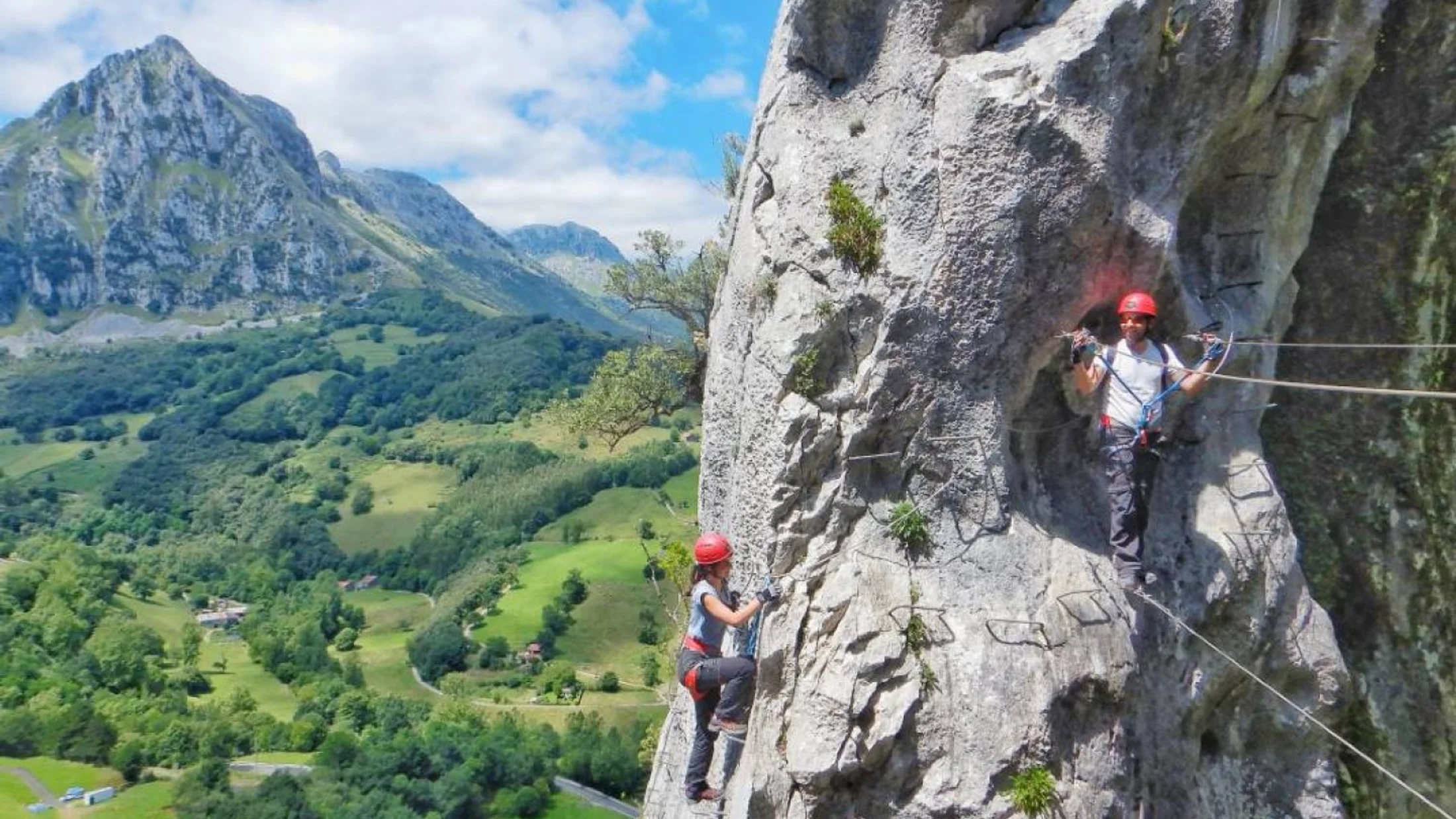
The La Hermida gorge, in the Deva valley between Panes and Potes, is a good place to start with via ferratas or to progress technically. The itineraries combine Tibetan bridges and guided zip lines.
The via ferrata has a 100-metre-long wooden walkway with a drop of more than 80 metres. There are other proposals in the area: El Milar, Escalera al Cielo (K3) and Peñarruscos (K6).
The level ranges from beginner (K2) to advanced (K4-K5); check the minimum age, normally 12-14 years. The activity lasts about 5 hours and costs 60-70 € per person with guide and equipment included.
The operator provides a harness, energy absorber and helmet; you bring gloves and stiff footwear. It is mandatory to register at the reception centre and book during high season. Follow the guide and always keep both carabiners clipped to the lifeline.
If you go in a mixed group, separate by levels to enjoy and maintain the pace.
Park only in designated areas.
3. Asón River: canyoning among waterfalls and natural slides
The Asón valley is a canyoning school in Cantabria: active limestone canyons with abseils (descending without a rope), rappels and water slides. There are beginner and intermediate sections, and experience is required during high water levels. It is a great option for a first water-based canyoning experience, with optional jumps.
The set includes the riverbeds of the Carranza, Bustablado, Gándara, Barranco de Astrón, Rovente and Argumal rivers. The operator provides the technical equipment (wetsuit, harness, helmet); you bring a swimsuit, towel and shoes that can get wet.
Before booking, ask about licences and insurance and confirm if there are mandatory rappels or escape routes. If you have never done canyoning before, choose a short section with non-mandatory jumps. Do not jump without checking the depth and follow the anchors and the guide's instructions.
The departure area is Ramales de la Victoria and Soba, with access via the N-629 and a stop in Gibaja, almost arriving at Ramales de la Victoria. Parking is limited: bring spare footwear for the car.
4. Deva River: rafting and kayaking in white water
The Deva flows with class III-IV rapids, one of the best white water options in Cantabria. The class measures the difficulty of the rapid, from I easy to VI extreme.
The usual rafting section goes from La Hermida (Salmón viewpoint) to Puentelles: a 12 km descent. Along the way, you pass Paso de Urdón, La roca, El Monchi tirador, El tren de olas and El Slalom.
In spring, the snowmelt increases the flow; in summer, the descents are smoother and more family-friendly. The best time for higher flow is from March to June; from July to September, the river is calmer.
Rafting costs 35-55 € p.p. and works well for groups of friends and families looking for adventure: there is a family mode from 7 years old. The included equipment is a wetsuit, life jacket and helmet; bring a swimsuit and footwear that can get wet.
The rafting service on the Deva River includes the transfer to the river launch point. Book in advance, as a minimum number of people is required per trip. If you get motion sickness on choppy sections, sit at the back and let the guide know.
If the group has energy left, combine the descent with a stop in Potes or with an afternoon via ferrata. You can also book rafting on the Deva River from Unquera.
5. Costa Quebrada (Suances and Liencres): surf and bodyboard with constant waves
Between Suances and Liencres, the Costa Quebrada brings together beaches and peaks with waves for all levels: Los Locos and La Concha in Suances, and Valdearenas or Canallave in Liencres. Local schools offer lessons and rent equipment all year round.
The level ranges from beginner to advanced. The wave breaks over a sandy and gravelly bottom, with barrels on big swell days. Summer is the time to learn; autumn-winter is the time for strong swells.
Bring a 4/3 mm wetsuit for most of the year; in winter, 5/4 mm and booties. Valdearenas is within a protected dune system in the Liencres Natural Park: respect the protected areas and use the public showers. There are no rental services on Valdearenas beach.
There are rip currents: follow the flags and the lifeguards' recommendations, and do not enter the water alone if you are unfamiliar with the spot or if there is a strong swell. Book your lesson during mid-to-high tide and park in the designated car parks in the area.
6. Potes and Liébana: horse riding trips through valleys and Pasiega cabins in Liébana
From Potes, a horse will take you along tracks through meadows, forests and villages in Liébana, with the Picos de Europa in the background. The animal's warm breath and the crunching of leaf litter accompany the ride.
The meeting point is in Potes, in the Liébana valley, and the level is adapted to the group: the usual minimum age is 8-10 years. It is a peaceful plan for couples and families.
Wear elastic long trousers and closed footwear, boots or trainers, and a lightweight waterproof jacket. For safety, an approximate weight limit of 95-100 kg applies.
Book and arrive 15-20 min before to get ready and adapt to the horse. Ask about routes with stops at viewpoints or villages for photos and rest.
7. Climbing areas: sport and bouldering between coast and mountain
You can climb in the morning and have a swim in the afternoon.
Ramales de la Victoria is the largest area in Cantabria: more than 200 routes in 10 sectors, with grades between IV and 8 and heights of 25 to 100 m. The Cuchía Climbing School adds more than 150 routes of all levels. There are routes ranging from beginner top-rope to endurance and overhang routes.
Estimate half a day or a full day. If you climb freely, bring a helmet, harness, climbing shoes, a 70 m rope and 14-16 quickdraws. The helmet is mandatory: check the sketches and anchors, and consider a federated insurance.
Respect the parking areas, do not block rural paths and pick up your litter. If you are starting out, book an introductory session with an emphasis on belaying and fall management.
8. El Soplao and other caves: caving among eccentric stalactites
El Soplao holds helictites and draperies, eccentric formations that grow in any direction. The cave can be visited in two ways: the tourist visit or adventure caving.
Adventure caving lasts between 2 and 4 hours and costs 36 € per person. The level ranges from tourist to technical beginner or intermediate, involving crawling and climbing. In the region, there are training caves to start progressively.
Wear thin thermal clothing and bring your own gloves, as they are not provided. The fresh, mineral air and the rhythmic dripping mark the underground journey.
Minors under 12 years old cannot enter the caving visit. Book in advance: spots are limited due to the fragility of the formations. Do not touch the formations, follow the guide line and have a basic level of physical fitness. The cave is closed on Mondays from October to June, and for tourist visits, it is advisable to arrive 20 min early to collect the tickets.
9. Pasiegos Valleys: MTB between meadows and local roads
The Pasiegos Valleys, in Cantabria, offer MTB routes. There are also technical loops with significant elevation gain for those who want more.
The Pas Greenways runs along an old railway track and is a simple option for families. It follows the main course of the Pas river, from its source to its mouth, and is a protected area declared a Site of Community Importance and a Special Area of Conservation.
To ride with more elevation gain, you have iconic mountain passes. Alto del Caracol has a viewpoint at the summit overlooking the valleys and the mountains. Puerto de Lunada connects with the Burgos valleys.
The smell of cut grass and the tinkling of cowbells mark your progress. Combine your pedalling with a stop at local cheesemakers and workshops, and confirm opening hours before setting off.
Wearing a helmet is mandatory; bring gloves and a waterproof jacket, and add lights for the greenway tunnels. Signage varies: download the GPX track and respect the livestock paths. Reduce your speed when crossing villages and give way to livestock and tractors. Avoid extreme mud after storms.
10. Santander Estuary and Oyambre: coastal kayaking between marshes and beaches
The Santander Estuary and Oyambre Natural Park are paddled in calm waters, with tides that change the landscape and more exposed sections near the sandbar and the mouth. It is an introductory outing in calm sea and estuary, and rises to a medium level if there is wind or swell.
The estuary invites you to read the sea and watch waders: bring compact binoculars to see great herons, curlews and terns. It works well for couples and families wanting to observe and have a swim.
Wear a windbreaker, a cap and footwear that can get wet. Book according to the tides and park in the designated ramps and beaches.
Check the tide coefficient and choose outings at high tide that progress to low tide, so the return is easier. Do not cross navigation channels without a guide and respect the protected areas.
Location map
The article includes an interactive map with markers by activity, level and recommended season, as well as meeting points and nearby car parks. The icons are distinguished by colour: blue for water, green for trails and orange for rock.
Filter by difficulty, time of year or type of experience, and narrow it down to "families", "beginners" or "advanced". By clicking on each marker, you can see a summary, the duration, the price range and quick recommendations.
You can export GPX/KML tracks when they are available and save the parking coordinates. On mobile, zoom in with two taps and use the "How to get there" button to open the maps app. On desktop, print a sheet with logistical recommendations and safety notes.
The links on the map lead to the corresponding section of the list to see more details and book. The layers are updated with seasonal access changes and relevant weather warnings.
Tips for choosing your activity well
Before booking anything, consider your physical condition, your age and your experience. If you can run 5 km without any problem, you can take on medium hiking and estuary kayaking; if you do sport occasionally, prioritise short and guided routes.
The weather in Cantabria changes quickly. Check the 48 h forecast and review the report the day before departure.
The season rules: the Picos are more stable from May–October, quality waves arrive in autumn and the rivers are alive in spring. Calculate the total time including transfers and briefing, and add a 20% margin. Also, set a budget per person that includes rentals, tolls or parking.
Regarding safety, choose operators with qualified guides, certified equipment and insurance. Ask for the cancellation policy in writing and check the refunds for bad weather. Evaluate the operator by their certifications, the guide/client ratio, equipment maintenance and recent reviews.
If you are travelling as a family, look for beginner levels, small groups, a clear minimum age and a nearby plan B, such as a beach or a village. Groups of friends work best when adjusted by levels, perhaps in two sub-groups, and with team activities like rafting. If you are travelling solo, prioritise outings with a flexible minimum and wide schedules. For reduced mobility, ask about adapted access at beaches, viewpoints and sightseeing tours: El Soplao offers sightseeing tours and caving routes.
The week before, train lightly with walks on slopes, mobility exercises and some cardio. Carry a light backpack with water, a salty snack, a windbreaker, sun protection and a basic first aid kit. And respect the environment: give way to livestock, keep quiet in nesting areas and shop at small local businesses.
Frequently asked questions
What level of safety should I expect?
The norm for active tourism activities in Cantabria is to have qualified guides, certified equipment (PPE on via ferratas and caving), a prior briefing and civil liability and accident insurance.
Before booking, ask about equipment inspections and the guide/client ratio. With those two pieces of information, you will know if the activity fits your level and that of your companion.
Do I need previous experience?
To start, no previous experience is needed: choose basic levels of surfing, K2-K3 via ferratas, class II-III rafting or simple canyoning. With those options, you learn just enough to enjoy the day without stress.
If you already have a foundation, communicate your experience to the company to adjust the itinerary. This way, the guide can calibrate the pace and difficulties to what you already know how to do.
How do I book and when do I pay?
In high season, book in advance: activity slots fill up in summer and during long weekends. Before finalising the booking, confirm the conditions and the meeting point in writing.
Payment is usually made online or at the base on the day of the activity. Check the deposit they require and the cancellation deadlines so you know what to expect if you change your plans.
Is there public transport and parking?
On the coast and in the urban areas of Cantabria, you have buses and commuter trains. To move through the valleys and the Picos de Europa, however, a car is the usual means.
If you go by car, only park in designated areas. In gorges, avoid narrow verges: they leave little space and make passing difficult.
What are reasonable prices?
In Cantabria, a surf lesson costs between 30 and 45 €, and surf equipment rental is between 15 and 25 €. A via ferrata or a canyoning outing ranges between 35 and 70 €.
Rafting goes from 35 to 55 €, and estuary kayaking is between 25 and 45 €. These are indicative ranges: compare what each proposal includes before deciding.
Book in advance, especially during high season and on weekends. This way, you ensure a spot in the activity you want and at the time that suits you.
What happens if the weather is bad?
In Cantabria, the weather changes quickly, so it is advisable to take it into account before booking. The operator may reschedule or cancel the activity for safety reasons, and that is why it is worth reviewing the refund policies before paying.
Book a plan B for bad weather days: cultural visits, thermal baths or museums. This way, the day still makes sense even if the mountain or the sea do not cooperate.
Is there environmental regulation I should know about?
Yes, and it is advisable to review it before heading out. Respect the signage in the parks, especially in Picos de Europa, Liencres and Oyambre.
Leave no trace of your passing through the environment. Also, pay attention to temporary access or nesting restrictions, which change depending on the time of year.
Book your experience — discover active tourism activities in Spain with providers verified by Picuco.
Conclusion
Cantabria brings together limestone gorges, tranquil estuaries and valleys within short distance of each other. That proximity allows you to put together a balanced getaway by combining several experiences from the list.
Plan with plenty of time, confirm the conditions and book with verified operators. During high season, do it in advance and travel light: the rhythm is set by the tide and the mountain.
Before choosing an activity, use the map to orient yourself and compare levels and seasons. At Picuco, you have directories of activities, tourist offices and downloadable equipment lists to dive deeper.