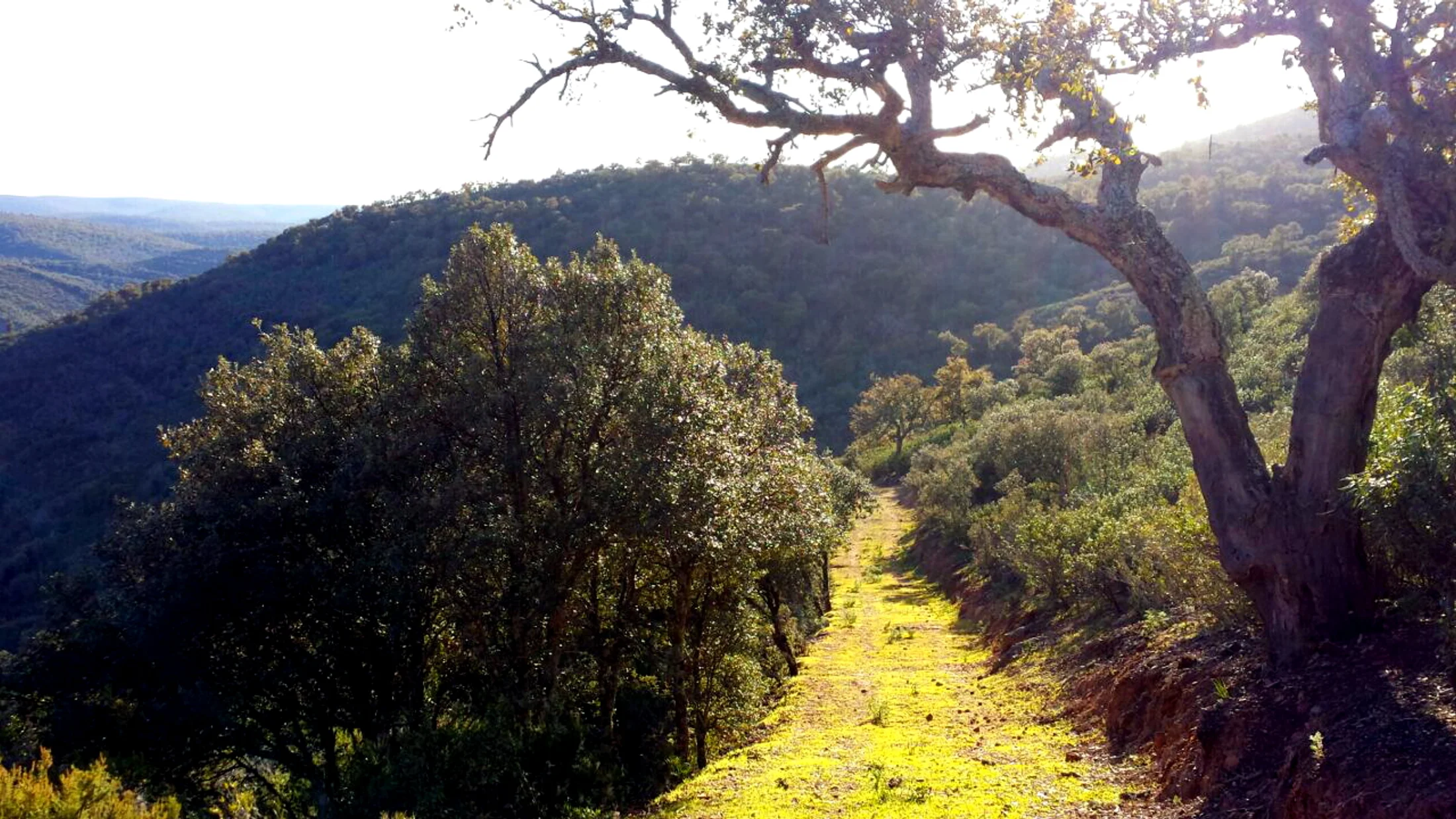
Cabañeros National Park spans 40,856 hectares across the provinces of Ciudad Real and Toledo, in the heart of the Montes de Toledo range. Declared a National Park in 1995, this territory preserves one of the best-conserved Mediterranean forest ecosystems on the Iberian Peninsula — a mosaic of open plains (rañas), mountain ranges, rivers and dehesas that naturalists have dubbed the "Spanish Serengeti" for its spectacular concentration of wildlife.
The raña, an undulating plain covered in grassland and dotted with scattered holm oaks, is Cabañeros' most recognisable landscape feature. From the elevated viewpoints of the sierra, the raña unfolds like a brown blanket rippling in the October wind, when male deer burst forth with their hoarse roar through the dawn mist. The berrea (deer rut), which takes place between mid-September and mid-October, draws thousands of visitors each year who come to hear that ancestral sound reverberating through the valleys.
The Mediterranean forest of Cabañeros displays exceptional botanical diversity. The sierra slopes are carpeted with holm oaks (Quercus ilex), cork oaks (Quercus suber), Portuguese oaks (Quercus faginea) and strawberry trees (Arbutus unedo), while riverbanks host ash groves, alder woods and tamujo shrubs. CSIC botanists have identified over 1,000 plant species within the park, including Iberian endemics such as tree heather (Erica arborea) in formations reaching six metres in height.
The fauna of Cabañeros alone justifies its National Park status. The Spanish imperial eagle, with fewer than 800 breeding pairs worldwide, maintains several stable breeding territories here. The cinereous vulture, Europe's largest raptor with a wingspan exceeding 2.5 metres, has one of its most important colonies on the Sierra del Chorito. The black stork, the Iberian lynx — successfully reintroduced in recent years — and the otter complete a roster of species that makes Cabañeros a sanctuary for threatened Iberian wildlife.
Ungulates dominate the raña. Herds of red deer (Cervus elaphus) numbering up to 200 individuals graze at dusk alongside fallow deer and wild boar. In spring, deer calves take their first steps among the new grass, a spectacle that park guides consider as memorable as the rut itself.
Cabañeros offers several waymarked trails for exploring its different ecosystems. The Boqueron Route follows the riparian forest along the River Estena, where light filters through alders and ash trees, creating an almost Atlantic atmosphere in the heart of the Castilian plateau. The Raña Route crosses the plain by authorised 4x4 vehicle with a guide — the most effective way to spot large mammals. The sierra routes, such as the climb to Pico Rocigalgo (1,448 m, the park's highest point), demand more effort but reward hikers with panoramic views across the entire territory.
The Casa Palillos Visitor Centre in Horcajo de los Montes and the Pueblo Nuevo del Bullaque centre provide up-to-date information on routes, permits and park conditions. Some routes require advance booking, particularly the guided 4x4 excursions across the raña.